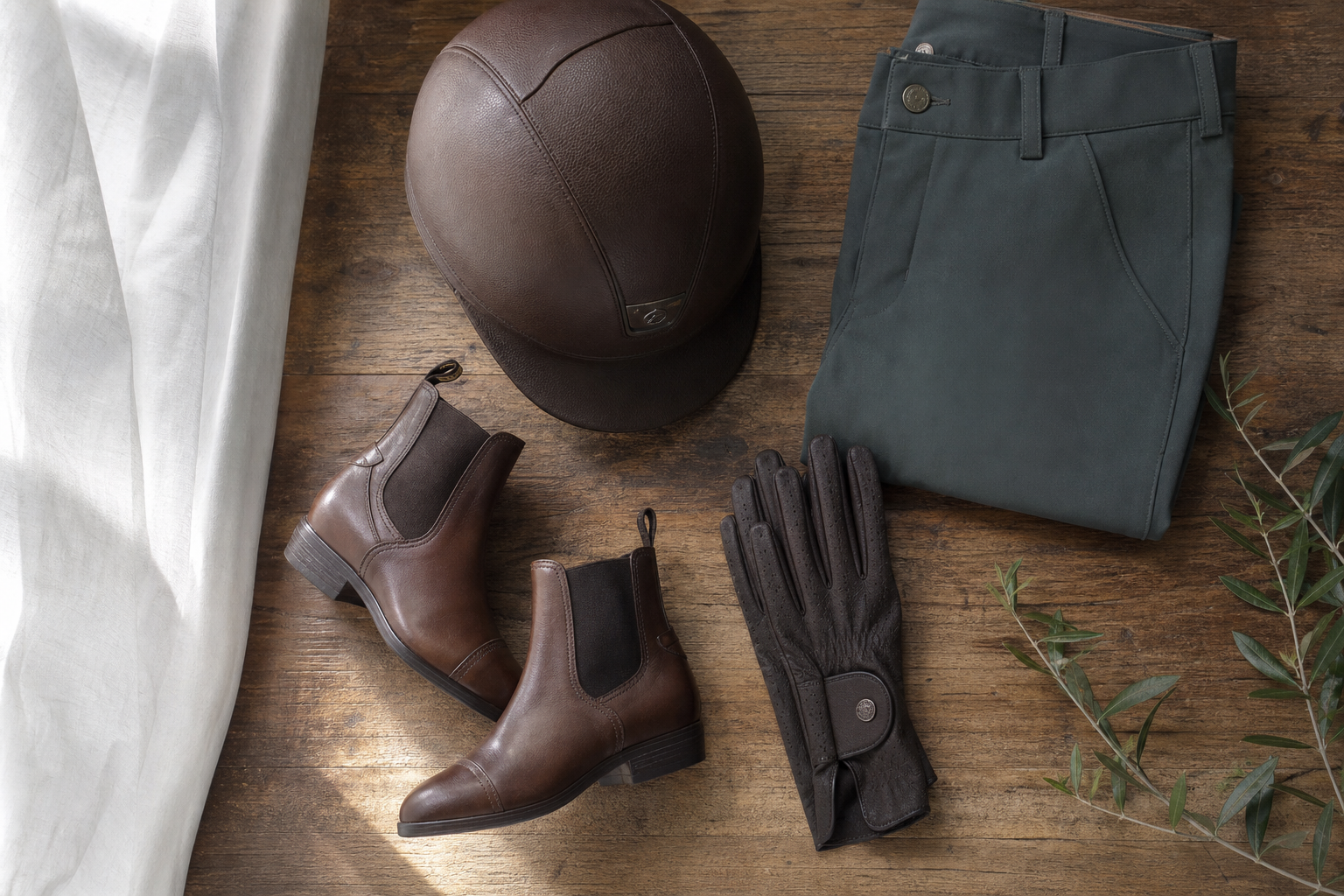
The equestrian industry has a gift for making new riders feel they must spend thousands before they can sit on a horse. Browse any equestrian retailer and the product categories multiply instantly: breeches, jodhpurs, half-chaps, full chaps, competition jackets, schooling jackets, saddle pads in twelve colours, ear bonnets, fly veils, bandages, boots in field, yard, and dress variations. It can be genuinely difficult to distinguish what is necessary from what is traditional, fashionable, or purely aspirational.
This guide is structured around a simple principle: start with safety, add function, and defer everything else. The items you genuinely need to ride safely are few. The items that make riding more comfortable and enjoyable accumulate over time as you develop a clearer picture of what you actually do in the saddle.
The non-negotiables
Two pieces of kit are genuinely non-negotiable: a correctly fitted riding helmet and appropriate footwear. Everything else is a matter of degree.
A riding helmet must meet the current safety standard relevant to your country and must fit correctly. In Europe, the relevant standards are EN1384 (the baseline), PAS015 (British standard, higher impact rating), and ASTM F1163 (American standard, also widely accepted). A helmet that meets only EN1384 but fits correctly is safer than a MIPS-equipped premium helmet that moves on your head. Try helmets in person where possible — fit varies considerably between brands, and the shape of your head determines which brands work for you regardless of price point.
The correct replacement interval for riding helmets is a subject of genuine debate, but the consensus among safety researchers is that helmets should be replaced after any fall that causes impact to the head (even if no visible damage is apparent) and after five years regardless of use. The foam liner degrades over time and with exposure to sweat, UV, and temperature variation. Budget helmets that fit well and are replaced regularly are, from a safety standpoint, superior to expensive helmets used past their service life.
Footwear needs a heel — a minimum of 1.5 cm — to prevent the foot from sliding through the stirrup, and a smooth sole that can release cleanly if you fall. Standard leather soled riding boots of any kind meet this requirement. Trainers, wellies, and hiking boots do not. For beginners at a riding school, most establishments require an enclosed toe and a heel, and most can lend you suitable boots if you are starting out before purchasing your own.
Trousers: what to wear and why
Riding in jeans is possible and many riders do it, but the inner seam sits precisely where a saddle will concentrate pressure over an hour of riding, and the result is discomfort and, in extended sessions, chafing. Dedicated riding trousers exist primarily to solve this problem by placing the seam outside the contact area or eliminating it entirely.
Jodhpurs are full-length trousers that fit close to the leg and are designed to be worn with short paddock boots or yard boots. They are the practical choice for most everyday riding. The reinforcement in the knee and seat area reduces wear and provides some grip in the saddle. For lessons at a riding school, a good pair of jodhpurs and paddock boots is entirely sufficient kit.
Breeches are cut to sit just below the knee and are designed to be worn with long riding boots. If you do not own long boots, you need half-chaps to cover the gap between the boot top and the breeches hem — a combination that effectively mimics a full boot for function if not for appearance. The choice between jodhpurs and breeches is largely one of preference and intended discipline rather than function; breeches are standard in dressage and jumping disciplines, jodhpurs in Western and casual riding.
Upper body: function over tradition
For everyday riding, there is no requirement to wear a dedicated riding jacket. A fitted sports layer — something that does not have excess fabric that could catch on equipment — is entirely practical. What you want to avoid is anything very loose, with hanging drawstrings, or with large external pockets that could snag.
If you ride in cold or wet conditions, a body warmer (gilet) over a base layer is more practical than a heavy jacket for most seasons, because it preserves arm mobility while keeping the core warm. Waterproof riding jackets are designed to stay in place in the saddle and prevent riding out in the wet from being miserable — standard hiking waterproofs tend to ride up and bunch around the waist when seated.
Gloves are not mandatory but are worth the small expense. Even a basic pair of riding gloves improves rein grip in cold or wet conditions and protects the palms from rope burn when leading or lunging. Synthetic gloves in the £15-25 range are entirely adequate for everyday use.
The footwear spectrum
Most new riders buy paddock boots first and expand from there. A paddock boot is an ankle-length boot with a heel and smooth sole, suitable for yard work, mounting, and riding. Paired with half-chaps, it covers the function of a full long boot at roughly half the price.
Half-chaps are leather or synthetic covers that wrap the lower leg from below the knee to the top of the paddock boot. They protect the leg from saddle rub, improve grip, and give a cleaner line that approximates a full boot. For a first purchase, synthetic half-chaps at a low price point are perfectly adequate — the material wears well and cleans easily.
Full long boots — either leather field boots or dress boots — are the eventual goal for many riders, but they are expensive, require fitting from a specialist, and need regular conditioning to maintain. They are a reasonable second-year purchase once you have confirmed riding is something you plan to continue seriously.
Yard boots or rubber yard wellies are separate from riding footwear and serve a different purpose: mucking out, handling horses on the ground, and wet conditions around the yard. They do not substitute for riding footwear and should not be confused with it.
What to defer
A short list of items frequently purchased by new riders that are worth deferring:
- Body protector: Essential for cross-country and jumping at height, strongly advised for riding young or unpredictable horses, optional for hacking and arena work on established horses. Assess your actual activity level before purchasing.
- Air vest: The inflating airbag vests (Hit Air, Helite, Point Two) provide excellent protection in a fall and are standard at competition level, but they are an additional cost on top of a body protector, not a replacement, and are primarily relevant once you are jumping or competing.
- Competition clothing: Competition jackets, show breeches, stock ties, and white gloves serve one purpose and look eccentric outside the show ring. Buy them when you have a competition date in your diary.
- Multiple saddle pads: One or two well-chosen saddle pads in neutral colours are sufficient for all purposes. The multiplicity of shapes, thicknesses, and configurations available is a function of fashion as much as utility.
Buying used
The second-hand market for equestrian kit is well-developed and offers genuine value for most items. Tack stores, specialist consignment shops, and online platforms all carry used breeches, boots, body protectors, and clothing in good condition at significant discounts.
The single exception is helmets. Never buy a second-hand helmet. A helmet that has sustained an impact — which is impossible to verify from appearance alone — may provide no protection at all in a subsequent fall. The cost saving is not worth the risk. Buy helmets new, buy them to your budget, and replace them on schedule.
Used saddles are a separate and complex topic involving fit, age, tree integrity, and reflocking — beyond the scope of a first kit guide. If you are buying your first horse and need a saddle, budget for a saddle fitter from the start rather than attempting to assess used saddles independently.
A practical first kit
For a rider beginning lessons at a riding school, the minimum practical kit is: a correctly fitted certified helmet, a pair of jodhpurs or breeches, paddock boots with half-chaps, and one pair of basic riding gloves. This costs, depending on brands and whether anything is bought used, somewhere between £80 and £200 for a complete set of functional, decent-quality pieces.
Everything beyond this point is incremental improvement based on your specific riding, your horse, your climate, and your preferences. Buy the minimum, ride in it, and let your experience tell you what to add next.
Written by
Anna Röst
Equestrian writer focused on northern breeds and riding culture.