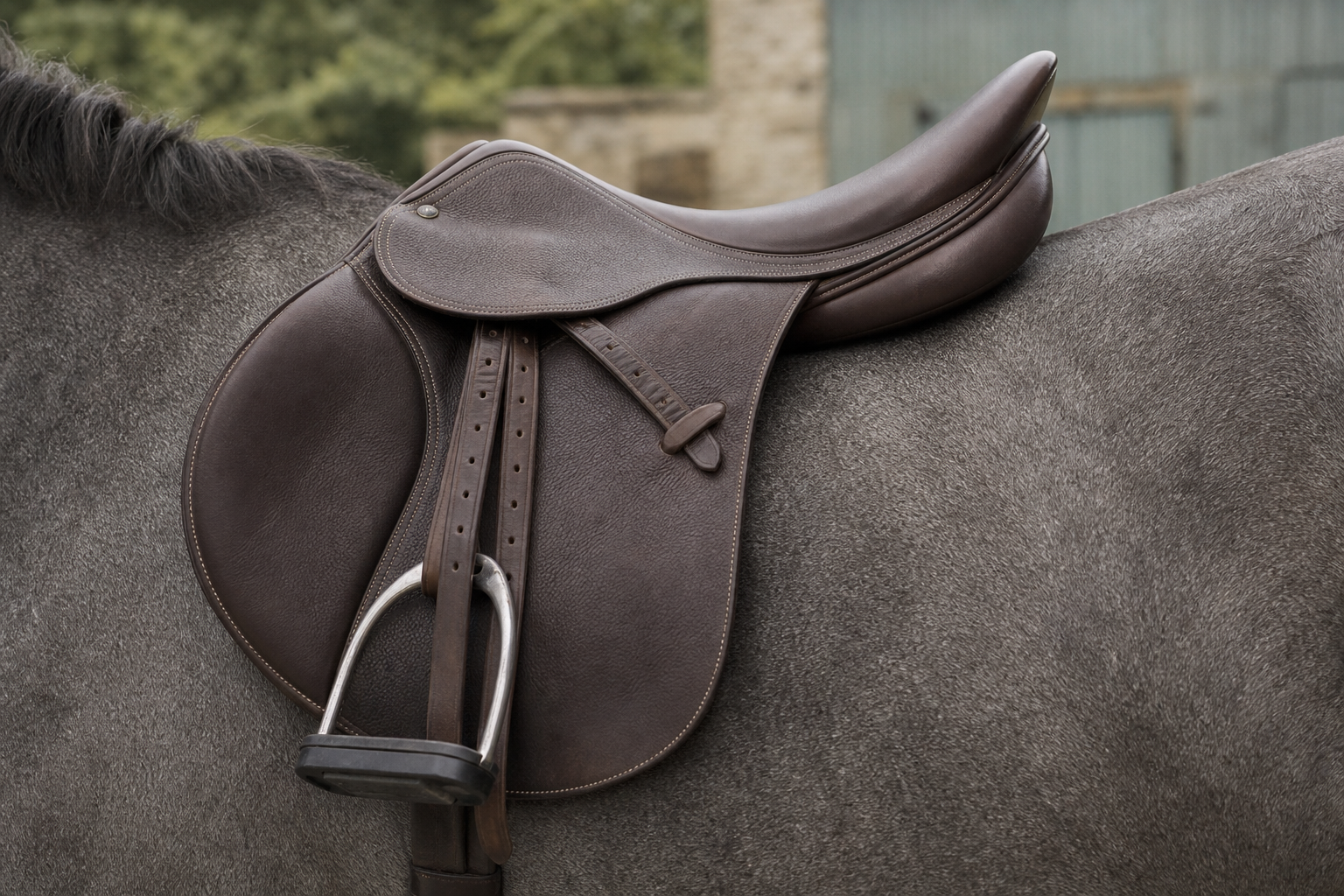
The saddle is the point of contact between two bodies that have nothing naturally in common — a human spine built for upright walking and a horse's back built to carry its own head and viscera. Getting this interface right is not a luxury. A poorly fitting saddle causes pain, alters movement, creates compensatory tension throughout the horse's musculature, and in time produces behavioural changes that are often misread as training problems. Saddle fitting is not an optional refinement; it is part of basic care.
Most horse owners understand this in principle but are unclear on what professional saddle fitting actually involves, how often it is needed, and what they themselves can reasonably assess between fitter visits. This guide covers all three.
What saddle fit involves
Saddle fitting is a two-part problem: the saddle must fit the horse, and the saddle must fit the rider. Both halves require assessment, and they are not independent — a saddle that positions the rider correctly on the horse may still be too wide or too narrow across the tree to distribute weight correctly on the horse's back, and a saddle that fits the horse may throw the rider into a chair seat or push them forward over the pommel.
A qualified saddle fitter (in the UK, certification through the Society of Master Saddlers is the relevant benchmark) will assess the horse's back in terms of width, shape, symmetry, and muscle development. They will measure the angle and width of the horse's withers, the curve of the back, and any asymmetry in musculature that indicates the horse is compensating for previous discomfort or injury. This is done both standing and — critically — under saddle with the rider's weight, because a horse's back shape changes with loading.
The saddle is then assessed for tree width relative to the horse's withers, gullet clearance (the channel running along the horse's spine must be clear of contact under full rider weight at all paces), panel contact and balance, and the position it places the rider. A saddle that rocks front-to-back or side-to-side, bridges across the middle of the back, or concentrates pressure on a small area rather than distributing it evenly across the panel is poorly fitted regardless of how it looks to the untrained eye.
The tree: the dimension that cannot be adjusted
Most saddle fit problems come down to tree width. The tree is the rigid internal frame of the saddle, and its angle at the pommel must match the angle of the horse's shoulder. If the tree is too narrow, the points of the tree dig into the trapezius muscles on either side of the withers on every stride. If the tree is too wide, the saddle drops and bears weight on the spine. Neither can be corrected by reflocking or shimming; they require a different tree.
This is why buying a used saddle without a professional assessment is high-risk. A saddle that fitted its previous owner's horse may bear no resemblance to what your horse needs, and tree problems are not visible to the non-specialist. Even saddles described as "wide" or "medium-wide" vary substantially between manufacturers, and an inch of difference in tree angle translates to a significant difference in how the saddle sits on a horse's shoulder.
What can be adjusted: flocking and balance
The panels of a saddle — the padded surfaces that contact the horse's back — are typically filled with wool flock or synthetic foam. Wool flocking can be added to, removed from, or redistributed by a qualified fitter to adjust the balance and contact of the saddle. This is the primary maintenance procedure for a fitted saddle and is distinct from the initial tree-width assessment.
A saddle that fitted well when new will gradually require reflocking as the panels compress under use and as the horse's musculature changes seasonally. Most fitters recommend a maintenance check every six to twelve months for horses in regular work, with reflocking as needed. A horse that gains or loses significant muscle through increased or decreased work, a change in diet, illness, or age-related change will typically need saddle reassessment sooner.
Signs of poor saddle fit in the horse
The most reliable indicators of saddle fit problems in the horse are behavioural and movement-related, not structural. A horse that has previously been willing but has become reluctant to work forward, that shows resistance when being saddled, that dips away from pressure during grooming over the back, that has developed a hollow or tense back in work, or that shows unexplained changes in gait should be assessed for saddle fit before any other explanation is pursued.
Visible signs include white hairs (indicating pressure points that have damaged the hair follicles — these are permanent and a clear record of past poor fit), muscle wastage directly behind the shoulder that creates a visible groove, and uneven sweat patterns after work. Dry spots in the centre of an otherwise sweated-up back indicate bridging — the saddle is in contact at the front and rear panels but not in between, concentrating pressure at the points of contact. The Horse has published extensive research-backed guidance on interpreting these signs, and any of the above should be treated as a prompt for professional assessment.
How often saddles need reassessing
A horse's back is not static. Seasonal weight changes, fluctuations in muscle condition with work level, age-related changes in topline, and recovery from injury or illness all alter the shape of the back and therefore the fit of the saddle. Using a horse weight calculator at each seasonal transition makes it easier to track these changes objectively rather than relying on visual assessment alone. A young horse in its first two or three years of work will typically require more frequent saddle adjustment than a mature horse in consistent work, because its musculature is developing and changing rapidly.
As a general guideline: professional assessment at least once a year for a mature horse in consistent work; at least twice a year for a horse whose workload or condition fluctuates significantly; and following any illness, significant layoff, or change in training programme.
The rider's fit
The rider's fit in the saddle is the less-discussed half of the equation. A saddle that places the rider's weight correctly — with a balanced, three-point seat and stirrup bars positioned so the leg hangs naturally under the hip — allows the rider to sit with minimal tension and to move with the horse. A saddle that pushes the rider into a chair seat (thighs angled forward, weight on the back of the seat) or pitches the rider forward makes balance and independent movement structurally difficult regardless of the rider's skill level.
The seat size, flap length, and block position of a saddle are the primary variables affecting rider fit. These are partly objective (a rider with long femurs needs a longer flap and potentially a larger seat) and partly a matter of discipline and preference. A dressage saddle is designed to position the leg longer and more vertical than a jump saddle; neither is wrong, but using the wrong saddle type for your discipline will always feel compromised.
For new horse owners, the practical priority is to budget for a professional fitting from the outset rather than attempting to assess saddle fit independently. The cost of a fitting session is modest relative to the cost of the saddle and is insignificant relative to the veterinary bills that accumulate when a horse works in pain for an extended period.
Written by
Anna Röst
Equestrian writer focused on northern breeds and riding culture.