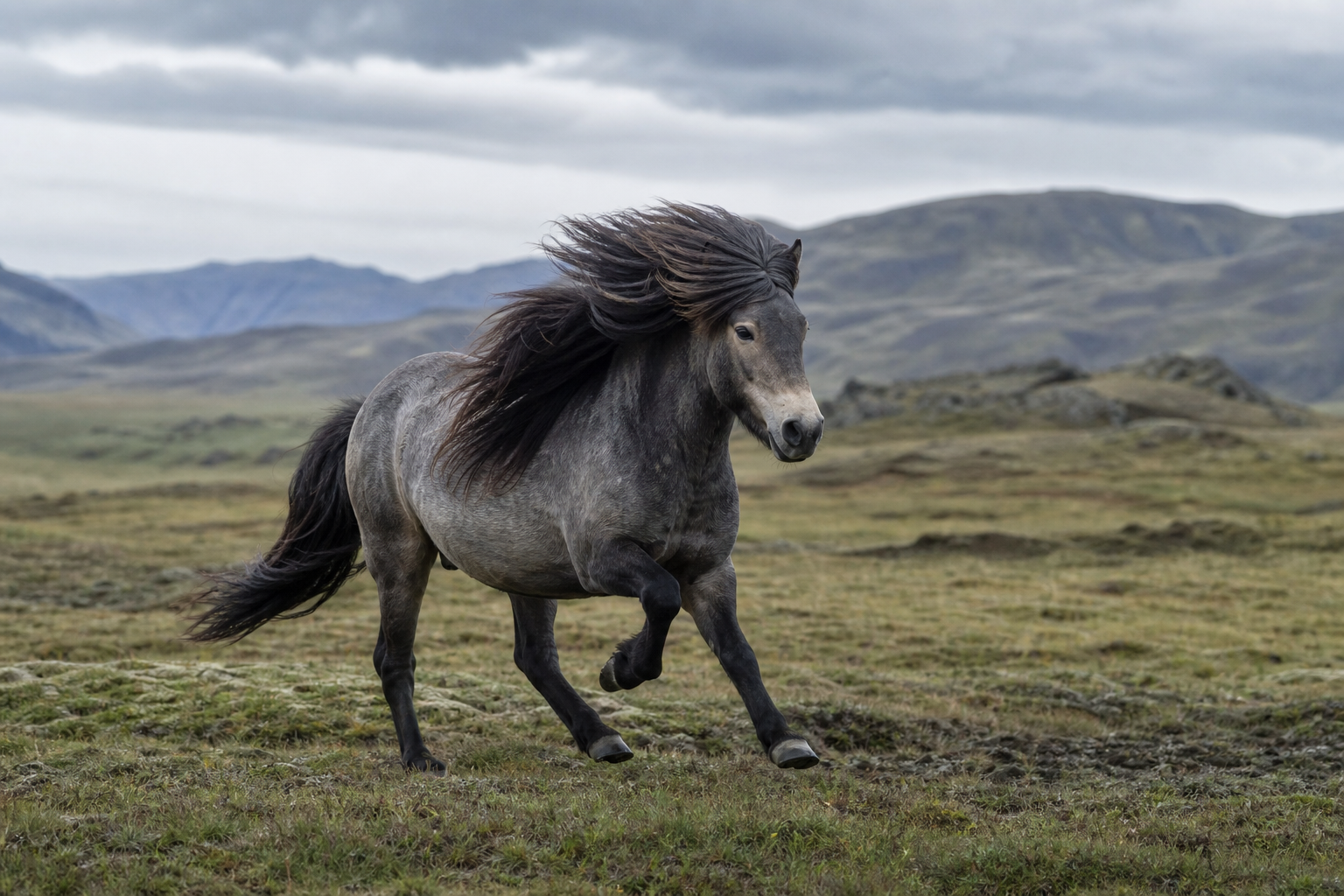
No horse breed in the world has been as carefully isolated as the Icelandic. When the first Norse settlers arrived on the island around 874 CE, they brought horses with them — small, hardy animals descended from northern European stock. What followed was more than a thousand years of geographic quarantine so strict that Iceland still does not permit the import of horses. An Icelandic horse that leaves the country can never return.
That isolation produced something extraordinary: a breed of exceptional genetic purity, adapted with precision to Iceland's volcanic terrain, sub-arctic winters, and sparse grazing. The Icelandic horse is not just a curiosity for enthusiasts of rare breeds. It is a working animal with a defined set of characteristics that make it unlike anything else in the equestrian world.
Origins and history
The horse arrived in Iceland with the first settlers, primarily from Norway but with likely contributions from the British Isles and Celtic lands. Early sagas record horses as central to Norse life — not only as working animals but as subjects of ritual, status, and sporting competition. Horse fighting, where stallions were made to battle, was a feature of Icelandic society until Christianity arrived in the year 1000.
During the famine years of the 18th and 19th centuries, the Icelandic horse population fell dramatically. At the lowest point, fewer than 30,000 horses remained on the island. Selective culling during these periods paradoxically helped refine the breed — only the hardiest animals survived. When prosperity returned, breeders worked to preserve the characteristics that had made the Icelandic horse indispensable: its gaits, its temperament, and its physical resilience.
Today, there are approximately 100,000 Icelandic horses in Iceland and another 100,000 across Europe, North America, and beyond. Breed societies operate in over 30 countries, all governed by the International Federation of Icelandic Horse Associations (FEIF), which maintains the studbook and competition standards.
The five gaits
The defining characteristic of the Icelandic horse is its gaits. Where most breeds perform three gaits — walk, trot, and canter — the Icelandic is capable of five, and the additional two are among the most distinctive movements in equestrian sport.
The tolt is a four-beat ambling gait in which one foot is always in contact with the ground, producing an exceptionally smooth ride at speeds comparable to a trot or canter. For a rider, the tolt feels almost like floating — there is none of the bounce that characterises a trot. Historical accounts suggest that Icelandic riders could carry a full cup of mead at the tolt without spilling a drop, a comparison that captures its quality better than any technical description.
The flying pace (flugskeið) is a two-beat lateral gait used at high speed — both legs on the same side move in unison, producing a galloping pace that can reach 45-50 kilometres per hour over short distances. The flying pace is used primarily in competition and requires specific training to develop cleanly.
Not all Icelandic horses are five-gaited. Horses that can perform both the tolt and the flying pace are called fimgengur (five-gaited), while those that can tolt but not pace are called four-gaited. Five-gaitedness is a heritable trait that breeders actively select for, and five-gaited horses command significantly higher prices.
Physical characteristics
The Icelandic horse stands between 130 and 145 cm at the withers — technically pony-sized by the international definition of 148 cm and below, though Icelanders and their breed standards do not use the word "pony" and find the classification mildly offensive. In frame, the Icelandic is compact and well-muscled, with a short back, deep chest, and notably thick, double-layered coat.
The coat is its primary adaptation to the Icelandic climate. In winter, it grows thick and insulating; in summer, it sheds completely to a short, shining summer coat. Icelandic horses kept in climates milder than Iceland often need management to avoid overheating — the coat does not always read its environment as precisely outside its native range.
Mane and tail are full and frequently long. The breed comes in a wider range of colours than almost any other, including rare patterns such as pinto (skewbald and piebald), silver dapple, and various forms of dun. More than 40 distinct colour designations appear in the FEIF breed standard.
Temperament and handling
Icelandic horses have a reputation for boldness that can surprise riders used to warmer, more reactive breeds. Because the breed evolved without large predators — Iceland has no wolves, bears, or large cats — it did not develop the same flight reflex that characterises many horses. An Icelandic will often approach an unfamiliar object rather than shying from it.
This makes Icelandics unusually forgiving for novice riders, but it also means they can be willful and opinionated. They have strong independent tendencies and do not always accept incompetent handling with the quiet resignation of a schoolmaster. They respond well to patience, consistency, and riders who understand pressure-and-release principles rather than relying on force.
Herd dynamics matter. Icelandic horses kept alone become anxious and difficult. At minimum, they need the company of one other horse, and preferably more. In Iceland, they are typically kept in large herds and allowed to self-organise social structures — a management philosophy that produces calmer, more socially competent animals.
Care and keeping
Icelandic horses are hardy and economical to keep by most breed standards, but "easy keeper" does not mean maintenance-free. Their metabolism is efficient to the point of being a liability in modern conditions — pastures that would be moderate for a Warmblood can cause obesity and laminitis in an Icelandic. Grazing management, particularly in spring and autumn when sugar content is high, is essential. Tracking weight through the seasons helps catch gains before they become a problem; a horse weight calculator using girth and body-length measurements gives a reliable estimate without a weighbridge.
Feet are typically strong and many Icelandic horses are kept unshod, particularly on the soft volcanic soils of Iceland. On harder surfaces or for horses in heavy work, shoeing is standard. Hoof care is otherwise straightforward — the feet are generally well-shaped and not prone to the structural problems common in some purpose-bred sport horses.
Lifespan is one of the breed's genuine advantages. Icelandics frequently live and work well into their 30s. A 25-year-old Icelandic in regular work is not unusual, and some breed records extend to 40 years. This longevity is partly genetic and partly a function of the low-stress management approach typical of Icelandic keeping — minimal stabling, high social contact, and work calibrated to the individual horse rather than a training schedule.
Competing with Icelandics
FEIF governs international competition across a disciplinary programme that includes gait assessment (where horses are evaluated at each of their gaits by judges), pace racing, and long-distance riding. The annual FEIF World Championships rotate among member nations and attract horses and riders from across Europe, North America, and further afield.
Competition gait assessment evaluates both the technical quality of each gait and the horse's overall impression — how it moves through transitions, how it carries itself, and how it responds to the rider. Scores are given for each gait individually and combined into an overall mark. Top-scoring horses at major shows represent the benchmark for serious breeders.
For recreational riders, competition is optional but the gait training framework offers a useful structure even for horses not shown. Working through the scales of training used in FEIF competition builds horses that are balanced, responsive, and pleasant to ride across all gaits.
Is an Icelandic horse right for you?
The Icelandic suits riders who value companionship and character over raw athletic performance. It is not the breed for someone who wants a horse primarily as an instrument of sport at the highest levels — it will never compete in grand prix dressage or Olympic showjumping. What it offers instead is a long-lived, psychologically interesting animal with a riding experience unlike anything produced by the warmblooded sport horse world.
Anyone considering ownership should spend time riding tolting before committing. The gait is extraordinary but it is not self-taught — both horse and rider need development to perform it well. Finding a reputable Icelandic-specific instructor or facility before purchasing is the most important single step a prospective owner can take.
Written by
Anna Röst
Equestrian writer focused on northern breeds and riding culture.