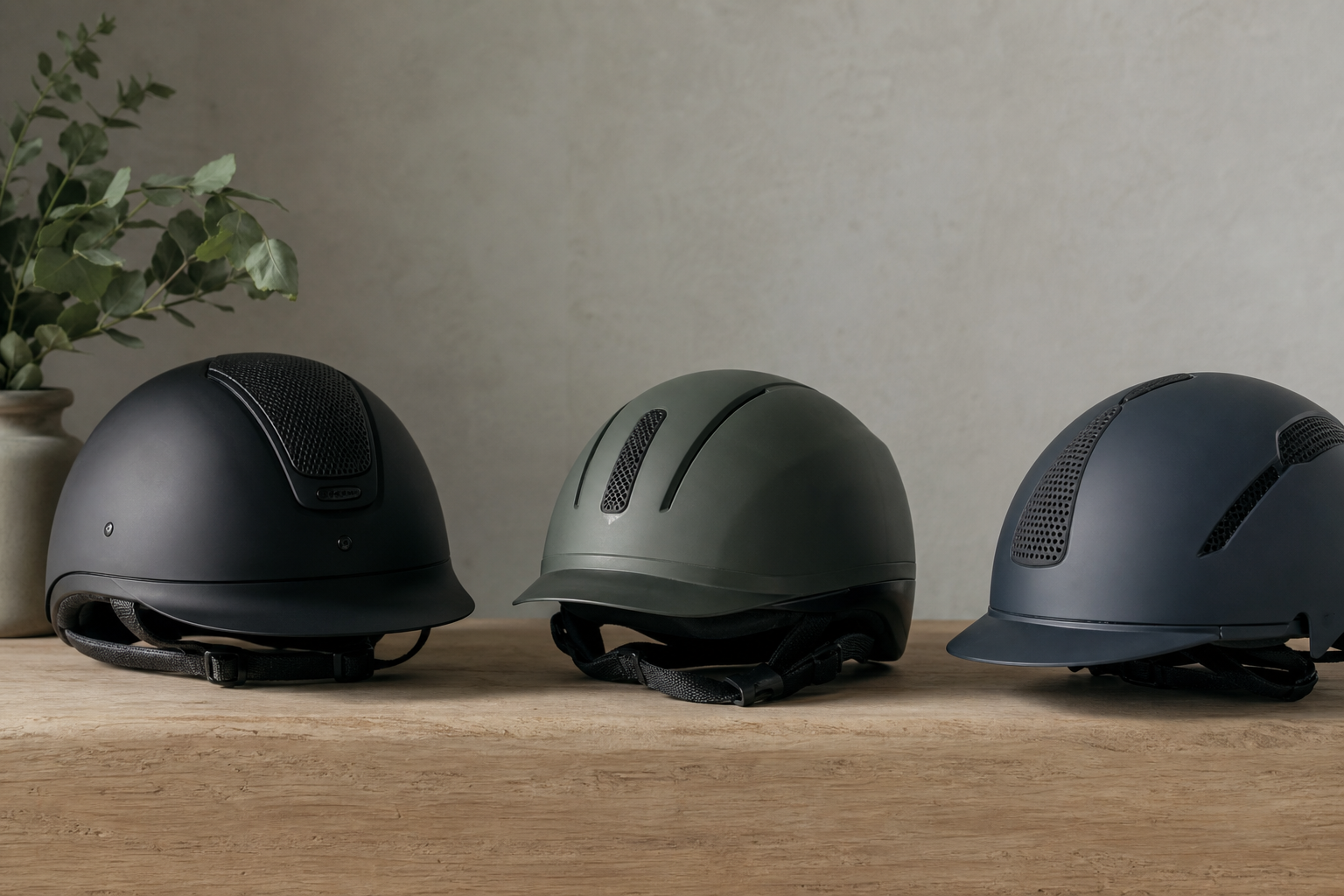
The riding helmet market is full of certification acronyms, and most riders who are not actively researching safety standards treat them as background noise. This is understandable — the differences between EN1384, PAS015, VG1, and ASTM F1163 are not obvious from a label, and retailers are rarely helpful in explaining what they mean in practice. The result is that many riders are wearing helmets they believe offer more protection than they actually do.
This guide explains what the main standards test for, how they differ from each other, and how to use that information when choosing a helmet.
What helmet standards test
All equestrian helmet standards are built around a core set of tests: impact attenuation (how well the helmet absorbs energy from a blow), retention (how securely the helmet stays on the head under impact), and rigidity (resistance to crushing). The tests simulate specific types of falls and impacts relevant to equestrian sport — primarily the falling rider striking the ground or an obstacle.
The tests do not simulate every possible fall scenario. No standard currently tests for rotational impact forces — the angular acceleration transmitted to the brain when a rotating head is suddenly stopped — which is increasingly understood to be a major mechanism in concussion and more serious brain injury. The MIPS (Multi-directional Impact Protection System) liner technology addresses this specifically, though it is a product feature rather than a certification.
Standards differ primarily in the severity of the impacts they test for, the range of angles tested, and the threshold of pass or fail. A higher standard does not mean a helmet is more comfortable or better built — it means it has passed more stringent physical tests.
EN1384 — the European baseline
EN1384 is the foundational European standard for equestrian helmets. It covers the minimum requirements for a helmet to be legally sold as equestrian headgear in EU and UK markets. The 2017 revision (EN1384:2017) tightened several thresholds compared to the previous version, and helmets sold today must meet the current edition.
EN1384 is the minimum, not the gold standard. Many entry-level and mid-range helmets are certified only to EN1384. This is acceptable; a correctly fitted EN1384 helmet offers meaningful protection and is far better than no helmet. But riders who jump, compete, or ride young or unpredictable horses often choose helmets certified to stricter standards.
PAS015 — the British higher standard
PAS015 is a British standard developed by the British Standards Institution that sets higher impact requirements than EN1384. Helmets bearing PAS015 certification have passed more stringent impact tests and are generally regarded as offering a higher level of protection. The standard is required for most British Equestrian Federation competition disciplines and is widely used as a benchmark by equestrian retailers and coaches in the UK and Ireland.
A helmet carrying both EN1384 and PAS015 certification meets both standards simultaneously — the tests are complementary rather than duplicative.
VG1 — the European alternative to PAS015
VG1 (Voluntary Guidelines 1) is a European standard developed as a higher-tier equivalent to PAS015, intended to fill the gap between EN1384 and the most demanding tests. It is increasingly accepted by major equestrian federations across Europe as meeting competition requirements where PAS015 is not specifically mandated. The test parameters for VG1 and PAS015 are broadly comparable, though they differ in some specifics.
If you are based in continental Europe and cannot find a helmet with PAS015 certification, a VG1-certified helmet at the same price point will typically offer equivalent protection.
ASTM F1163 — the American standard
ASTM F1163 is the primary equestrian helmet standard used in North America, maintained by ASTM International. Like PAS015, it represents a higher standard than the EU baseline. ASTM-certified helmets are required for competition in most North American equestrian disciplines and are widely used by riders in the US, Canada, and Australia.
ASTM F1163 and PAS015 have been periodically benchmarked against each other; the consensus in safety research is that they offer broadly similar levels of protection, though the specific test methodologies differ.
MIPS and rotational impact
MIPS is not a safety standard but a technology — a low-friction layer inside the helmet that allows the shell to rotate slightly relative to the head on oblique impact, reducing the rotational forces transmitted to the brain. It is available in helmets across a wide price range.
The research on rotational impact protection in equestrian helmets is not yet standardised into certification requirements, but the direction of travel is clear. Laboratory testing consistently shows that MIPS or equivalent technology reduces rotational acceleration in oblique impact scenarios. Several premium helmet manufacturers have developed their own rotational protection systems under proprietary names, and the differences between them are mostly minor in practice.
If you are choosing between two helmets of similar price and both meet PAS015 or ASTM, the one with rotational impact protection is likely the better choice on current evidence.
Fit remains the primary variable
All safety standards assume that the helmet fits correctly. An EN1384 helmet that fits your head precisely will protect you better than a PAS015 helmet that moves on impact. As outlined in our guide to building your first riding kit, fit is the non-negotiable starting point — and it must be assessed in person, not ordered by hat size.
The correct fit requires no movement of the helmet when the chin strap is fastened, the front of the helmet sitting two finger-widths above the eyebrows, and even contact pressure around the entire circumference of the head. Different brands fit different head shapes. The only way to identify which brands work for your head is to try them.
Replacement intervals
The standard advice is to replace a riding helmet every five years under normal use, and immediately after any significant impact — including falls in which the helmet struck the ground, even if no visible damage is apparent. The EPS foam liner that absorbs impact energy cannot be visually inspected for fatigue; it degrades with UV exposure, temperature cycling, and sweat absorption regardless of whether the helmet has been struck.
The five-year interval is a conservative guideline. Helmets used intensively in competition or training may warrant more frequent replacement. Helmets stored in good conditions and used occasionally may remain serviceable longer — but the risk of extending use beyond the guideline is borne entirely by the rider.
Written by
Anna Röst
Equestrian writer focused on northern breeds and riding culture.