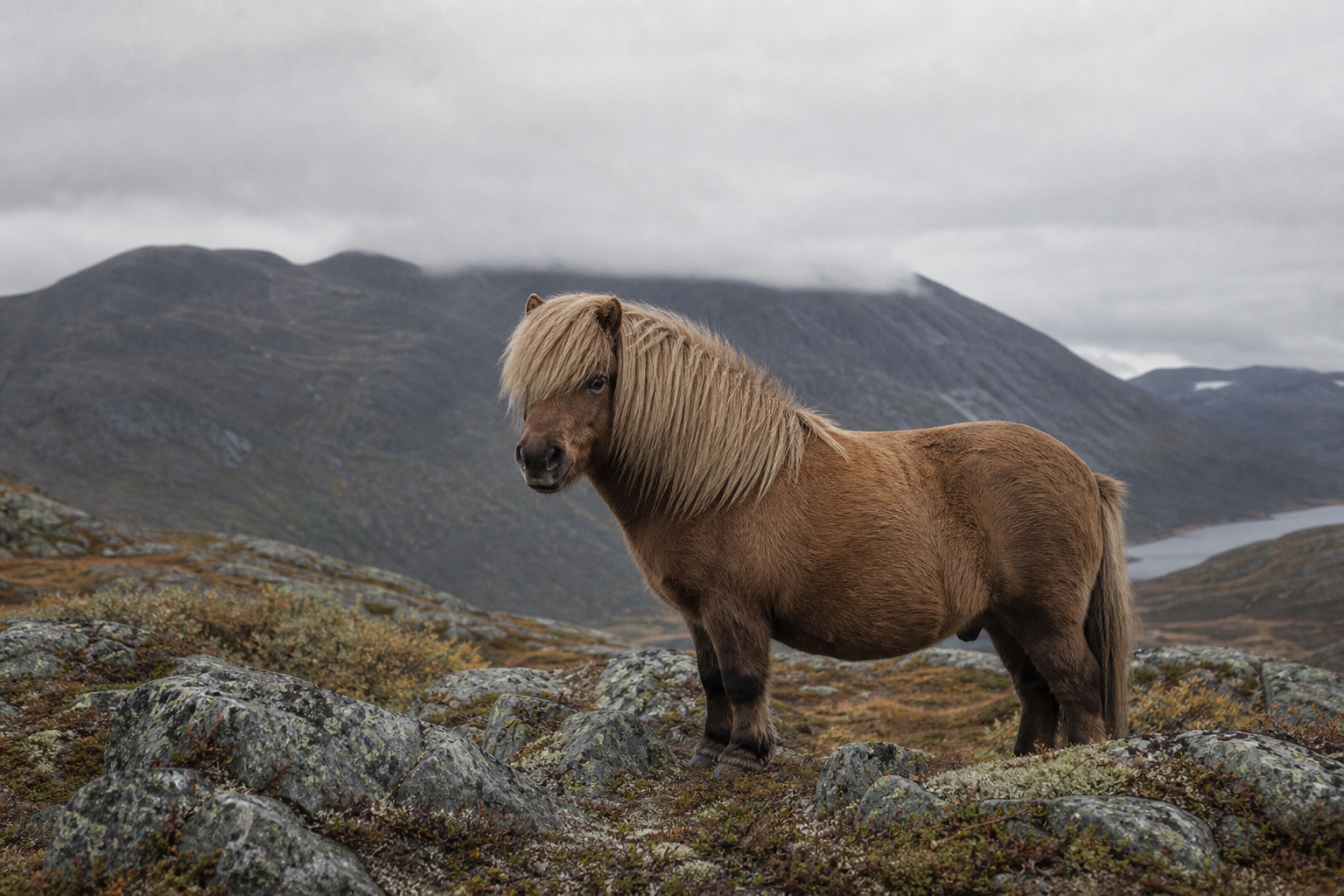
In the mountain districts of northern Norway, a small horse has been working alongside people for thousands of years. The Nordlands Pony — also known as the Lyngshest after the Lyngen peninsula in Troms where many of the finest specimens were bred — is one of the least-known native breeds in Scandinavia and one of the most quietly impressive. Compact, long-lived, and possessed of a hardiness that reflects its origins in one of Europe's most demanding environments, it has survived both population collapse and deliberate revival to remain a living part of Norwegian rural culture.
Origins and history
The origins of the Nordlands Pony predate written records. Archaeological evidence from Norway suggests that small native horses have inhabited the region since at least the Bronze Age, and the breed's bloodlines contain traces of multiple ancient northern European strains. During the Viking period, horses of this type were used for farm work, transport across difficult terrain, and — like their Icelandic cousins — in ritual and competition.
The breed's numbers dropped sharply during the 19th and early 20th centuries, partly as a result of agricultural mechanisation and partly through careless crossbreeding with imported stallions. By the mid-20th century, the population had fallen to critically low levels. Dedicated breeders in Nordland and Troms began organised efforts to preserve the remaining pure-bred animals from the 1960s onward, establishing studbooks and selecting stallions carefully for type.
Today, the breed remains rare — the total population across Norway numbers in the low hundreds — but it is stable and actively bred. The Norsk Hestesenter (Norwegian Horse Centre) maintains the national studbook, and interest from riders seeking capable, easy-keeping ponies has grown steadily over the past two decades.
Physical characteristics
The Nordlands Pony stands between 125 and 142 cm at the withers, placing it firmly in pony territory, though its proportions and presence read more as a small horse than a traditional pony. The build is compact and muscular, with a broad forehead, short back, deep girth, and notably dense bone. Legs are strong and clean, with hard hooves that typically require little corrective work.
The coat grows exceptionally thick in winter — a double layer of coarse outer hair over a dense, insulating undercoat — and sheds completely to a finer summer coat. The mane and tail are full and often wavy. Common colours include bay, brown, black, grey, and dun; the breed occasionally produces chestnuts, and some lines carry the primitive dun colouring with dorsal stripe and leg barring.
The characteristic the breed is perhaps most known for — outside Norway, at least — is its feet. Nordlands Ponies develop dense, well-shaped hooves that remain sound on rocky terrain without shoes. Many owners in traditional keeping environments leave their ponies unshod year-round. This is partly genetics and partly a product of the terrain they evolved on: the rocky, wet ground of coastal northern Norway is unforgiving of weak feet, and the breed has been selected over centuries for soundness.
Temperament and character
Nordlands Ponies are calm and cooperative without being dull. They have a characteristic curiosity that makes them engaging to work with — an interest in people and their surroundings that is shared with other northern breeds. Unlike some native ponies that maintain a degree of aloofness or independence, the Nordlands Pony tends to form strong bonds with its handlers and responds well to consistent, patient work.
Compared to the Icelandic horse, which shares a broadly similar background, the Nordlands Pony is somewhat more conservative in temperament — less likely to walk boldly into new situations, more likely to stand and assess. This is not timidity; it is the careful, measured response of a breed that evolved in an environment where caution had value. With time and consistent handling, most Nordlands Ponies become confident and willing partners.
Their intelligence is a genuine asset, but it also means they notice inconsistency. A Nordlands Pony handled by multiple people with different approaches will pick up on the contradictions and test its handlers accordingly. They respond best to clear, fair boundaries applied consistently.
Uses and disciplines
Historically, the Nordlands Pony was a general-purpose farm and transport animal, used for everything from ploughing and log-pulling to carrying packs across mountain passes. This work shaped a versatile, sound animal capable of sustained effort over difficult terrain.
In modern use, the breed excels in children's riding and pony club work, trail and endurance riding, light driving, and general leisure riding. Its compact build and natural balance make it a capable jumper for its size. Some enthusiasts have also used Nordlands Ponies successfully in dressage competitions at lower levels, where their natural cadence and trainability are an advantage.
The breed's particular strength is long-distance trail riding in difficult terrain. Its feet, endurance, and the self-sufficiency bred into it over centuries make it an exceptional trail pony in conditions that would exhaust or unsound a less hardy breed.
Keeping a Nordlands Pony
Nordlands Ponies are extremely economical to keep. Their metabolism is efficient, their grazing instincts are well-developed, and they manage on rougher pasture than most sport breeds require. The same care that applies to Icelandic horses regarding spring grass and laminitis risk applies here — both breeds evolved on sparse northern grazing and can become overweight on the richer pastures typical of lowland farms.
The breed is generally long-lived and healthy. Serious hereditary problems are rare in the remaining pure-bred population, partly as a result of the careful selection during the revival period that actively avoided introducing compromised bloodlines. Veterinary care follows standard pony protocols; the main breed-specific concern is foot care, and specifically ensuring that the hooves are not neglected in climates wetter than the breed evolved in.
Outside Norway, Nordlands Ponies remain genuinely rare. Small populations exist in Sweden, Germany, and the Netherlands, and a handful of enthusiasts in the UK and North America have imported animals. For anyone interested in northern breeds and looking for an alternative to the more widely kept Icelandic, they represent one of the most rewarding and least-crowded corners of equestrian life.
Written by
Anna Röst
Equestrian writer focused on northern breeds and riding culture.